Repairs · Nestleton Station
Garage Door Panel Replacement in Nestleton Station
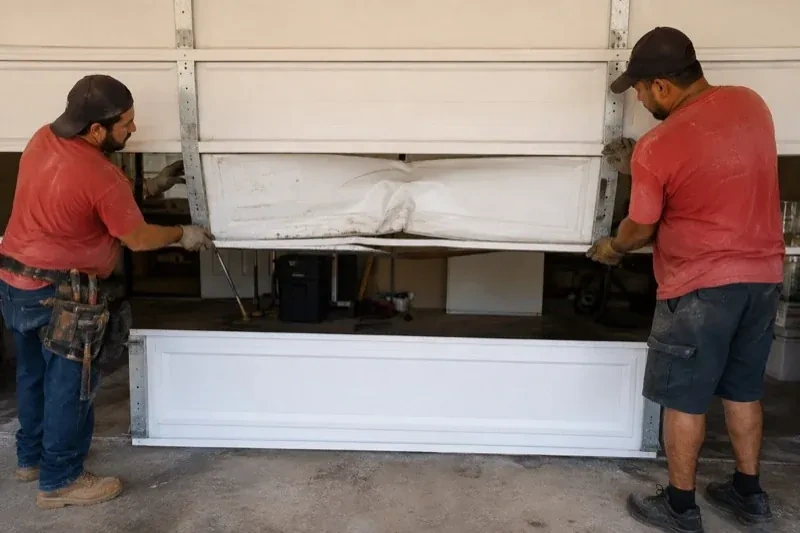
Rust has crept along the bottom edge of the lowest section. What began as bubbling paint is now a soft, flaking strip, the seal retainer is working loose, and a screwdriver pressed against the worst spot goes through the steel.
Garage Door Panel Replacement
In plain words
Everything about a section replacement flows from knowing exactly which door you have. Two doors that look alike from the driveway can differ in section height, thickness, the shape of the joint where sections meet, where the hinges bolt on and how the skin is embossed. A new section has to share all of those details to seat cleanly against its neighbours. So the visit starts with a hunt for the manufacturer's label, usually on the edge of a section or on the track, followed by measurements and photographs. With that identity confirmed, the right section can be ordered with confidence rather than hope.
How the visit goesAfter an overnight freeze the door stuck to the slab, the opener strained, and something gave. The bottom section is bowed inward, one hinge has torn free of its screws, and the rubber seal along the bottom no longer sits flat.
Nestleton Station
How the visit goes
What the impact did to everything else
Trade-association guidance is clear that after a vehicle strike, a storm or a freeze-up the whole door is looked at, not just the dented part. The technician runs a hand along the hinges for cracks and pulled screws, spins each roller for flat spots and bent stems, sights down both tracks for kinks and checks the brackets that hold them to the jambs. Cables are inspected for fraying where they wrap the drums, spring anchors and the centre bearing plate are checked, and the opener arm and its bracket are examined for bending. Anything the impact disturbed goes on the list alongside the section.
Locking the door before anything comes loose
The exchange begins with the door closed, the opener disconnected at the release cord and its power unplugged, and a pair of locking pliers clamped onto each track just above a roller. Held that way, the door cannot creep up or slip down while a section is missing from it, and the sections above the gap have something to rest on. The technician then removes the section's rollers and hinges in an order that keeps the neighbouring sections supported, working from one side to the other. Nothing under spring tension is touched at this stage on a middle or top section; the springs stay loaded and simply hold still.
A record of the door for next time
You leave with the door's identity written down: manufacturer, model or series, section height and thickness, panel design, colour code and the position of the section that was replaced. Keep it with the house papers or photograph it and file it on your phone. The next time a section, a hinge or a set of rollers is needed, that record turns a search into a straightforward order. It also tells any future technician what has already been changed and when, which helps them judge the rest of the door's age and condition without guessing.
Garage Door Panel Replacement
In the van
- Nylon or steel rollers
- Winding bars and track clamps
- Horizontal reinforcement strut
- Bottom seal retainer and astragal
- Window frame insert and glazing
What affects the quote
Same fees day, night or weekend
1Windows in the section
A glazed section carries frames, glass and sometimes decorative inserts, each specified with the order. A section with windows is quoted as a glazed section; adding windows where there were none changes the line as well.
2Construction and insulation
An uninsulated steel section, a polystyrene-cored section and a polyurethane-injected section with a steel backer are different products, and the replacement has to match the construction the door already has, which sets the part's line on the quote.
3Access and working room
A section is wider than the door opening and is carried in and manoeuvred by two people. A cluttered garage, a low ceiling around the spring, or a tight driveway adds handling time.
Garage Door Panel Replacement: questions
What happens if my door's design has been discontinued?
It happens with older doors, since embossing patterns, joint profiles and colours change over the years. The technician looks for the nearest current section from the same manufacturer and describes how it would differ in look and fit. Sometimes the difference is minor and acceptable; sometimes the joint no longer mates. In that case the options are a section from a compatible series, or replacing the door as a whole, and both are explained before anything is ordered.
Will the new section match the colour of the rest of the door?
It will match the factory colour your door was made in, which is not quite the colour your door is today, because paint fades in sun and weather. A fresh section can look noticeably brighter than its neighbours, and that difference may not go away with time. If the contrast bothers you, the whole door can be painted with an exterior product suited to the finish. Ask to see the current colour chip against your door first.
What information or photos help before the visit?
A photograph of the whole door from outside, a close-up of the damaged section, a picture of the manufacturer's label if you can find it, and a shot of the inside of the door showing the hinges, tracks and springs. Add the door's approximate width and height, whether it is insulated, its colour and panel style, and how the damage happened. That set often lets the technician confirm availability before arriving.
Repair & Maintenance
- Garage Door Tune-UpOn windy nights the door rattles in its frame, there is a line of daylight along one side, and the…
- Off-Track Garage Door ResetThere was a loud bang from the garage, then silence.
- Garage Door Bottom Seal ReplacementEvery mild afternoon the snow melts off the car, runs to the door, and by morning the rubber strip…
Garage Door Panel Replacement near you
If your door in Nestleton Station is doing something new, there is a service here for it. Grinding usually points to rollers or hinges. A door that will not lift points to a spring or cable. A door that reverses on its own points to sensors or force settings. We diagnose first, then repair.