Repairs · Scugog
Garage Door Safety Inspection
On bright afternoons the door goes down a metre, stops, and climbs back up while the light on the opener blinks. After dark it closes perfectly.
Garage Door Safety Inspection
In plain words
Three tests sit at the heart of the visit. The balance test, done with the opener disconnected, shows whether the springs are still carrying the door's weight or the motor is straining to do it. The contact-reversal test, a flat board laid on the floor, shows whether the door backs off when it meets something solid. The photo-eye test, breaking the beam while the door closes, shows whether the sensors stop it before contact. Each one takes a minute, each answers a different question, and together they tell you the door is doing what it was built to do.
How the visit goesThere is a new sound. Last week the door simply hummed up and down; now there is a bang at the top of travel and a scrape on the way back, and you have started standing well back while it moves.
Scugog
How the visit goes
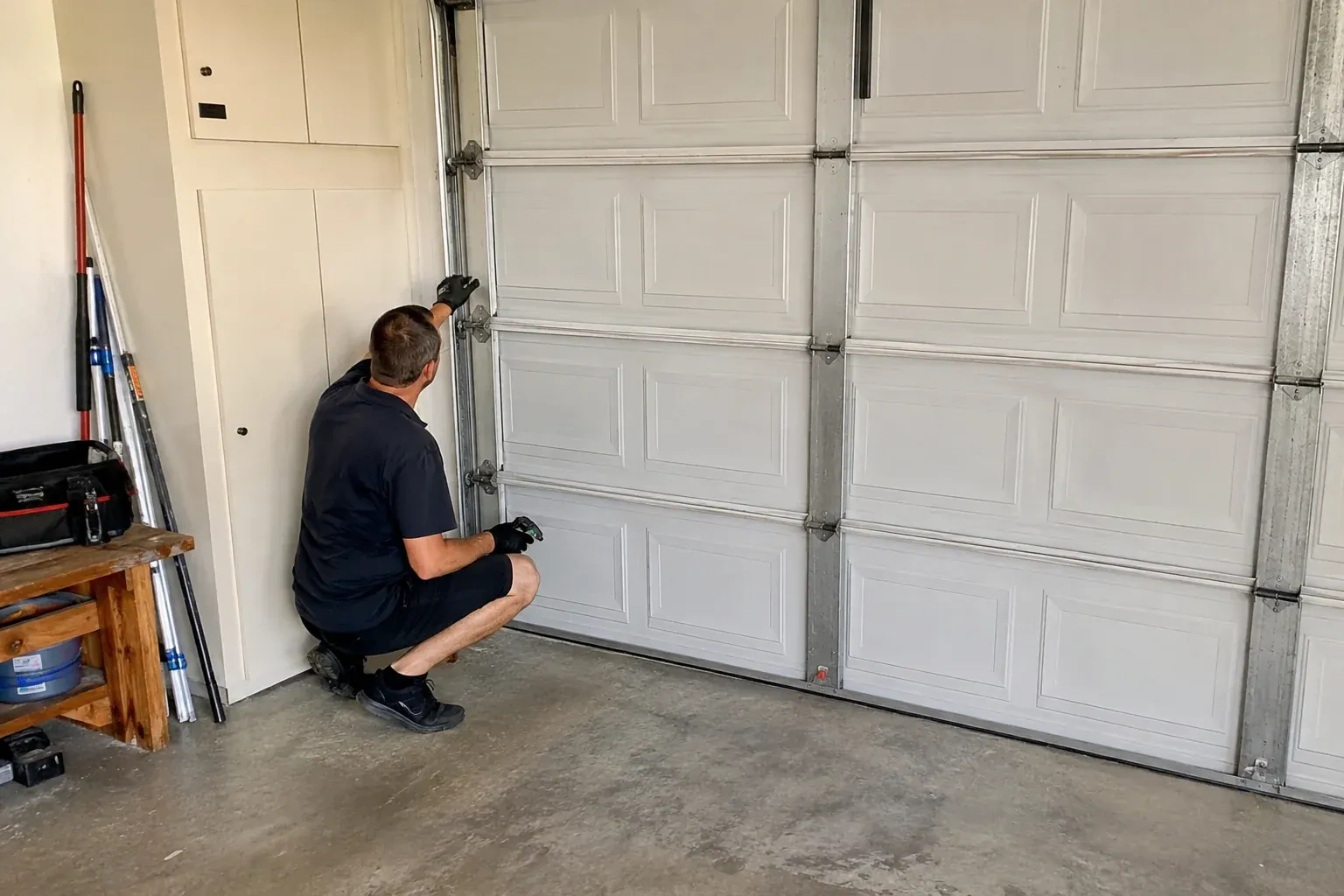
A slow walk along the closed door
With the door down and the light on, the technician looks at every section from the top down: dents, bowing, cracked stiles, a strut that has come loose. Each hinge is checked for a split leaf or a missing bolt, each roller for a cracked wheel, a bent stem or one that slides instead of turns. The tracks are sighted for plumb and even spacing from the door, and each track bracket and lag into the jamb is checked for tightness. This is unhurried work with a light and a mirror, and it finds the small things, a hinge working loose, a roller stem walking out, that become the big noise next season.
Maintenance done on the spot, if you wish
Some findings are simply maintenance, and with your agreement the technician handles them during the same visit. A garage-door lubricant is applied to the springs along their length, to hinge pins, roller bearings and bracket pins, then the door is run to spread it. The tracks are wiped clean and left dry. Photo-eye lenses are cleaned and aligned, loose fasteners tightened, remote and keypad batteries replaced. None of this touches the counterbalance tension or the opener's force settings; those are noted for planned work. It adds a few minutes to the visit and it means the door goes back into service better than it was found.
Signs that call for a visit before the next scheduled one
A few things are worth a call the day you notice them: a door that hangs crooked or stops part-way; a cable that looks slack, frayed or wrapped where it should not be; a gap in a torsion spring coil; a door that suddenly feels heavy on the manual release; an opener that reverses for no reason after the photo eyes are wiped; or a deep dent, one from an impact, or one dragging in the track. In each case, leave the door as it is, keep people and vehicles clear, and use another door until it has been looked at. A small cosmetic dent that leaves the door running smoothly can wait for the planned appointment.
Garage Door Safety Inspection
In the van
- Tape measure and level
- Weatherstrip samples for matching
- Lens cloth and cleaner
- Work light and inspection mirror
- Inspection checklist and report form
What affects the quote
Same fees day, night or weekend
1Access to overhead track or a locked mechanical room
Some tracks run behind storage or into a locked mechanical room, and reaching every bracket and fixture takes longer when a ladder or a key has to be found first. Clearing a path to the track ahead of the visit lets the inspection move through the whole door without interruption.
2A retest after repairs
When the report lists repairs, a short return visit to rerun the balance, reversal and photo-eye tests once the work is done is quoted as its own item.
3Single or double door
A double door is wider and heavier and commonly adds centre hinges and reinforcement a single door does not carry, with a heavier counterbalance to test, so it takes longer to walk and to write up; section count itself follows the door's height rather than its width.
Garage Door Safety Inspection: questions
Will the springs be adjusted while you are there?
No, and that is deliberate. An inspection reads the counterbalance: the technician checks the coil, measures wire size and length, and watches how the door behaves by hand. If it is out of step with the door's weight, the report says so and by how much. Winding a spring is its own appointment, done once the door is clamped and the system is calm, which keeps the inspection record honest about the door as found.
My door is quite old. Is an inspection still worthwhile?
Yes, and often more so. Age alone does not say how much life is left in a spring or a roller, but condition does, and an inspection measures condition. Many older doors are sound and simply need a few worn parts and fresh lubricant. Where the report shows several items coming due at once, you can weigh planned repairs against a new door with real information rather than a guess.
Should I have the door inspected when buying a house?
It answers the questions a home inspection leaves open. A general inspector confirms the door opens and closes; a door technician records the make and age of the hardware, how much life the springs and cables appear to have, whether the safety devices pass, and what to budget for. For a seller, the same report settles a buyer's questions before they are asked and shows the door was cared for.
Repair & Maintenance
- Off-Track Garage Door ResetThere was a loud bang from the garage, then silence.
- Garage Door Panel ReplacementRust has crept along the bottom edge of the lowest section.
- Garage Door Bottom Seal ReplacementEvery mild afternoon the snow melts off the car, runs to the door, and by morning the rubber strip…
Garage Door Safety Inspection near you
People in Scugog call about garage doors for many reasons, and we have a service for each: the door that stopped, the one that got loud, the one that lets in cold air, the remote that died, the panel that got dented, and the door that has simply had its day.